Most dog owners start shopping for a GPS tracker with no subscription fees because they priced a monthly plan and did the math on three years. I understand the instinct. After four years of logging trackers on trail, I can tell you the monthly fee is not the expensive part. The expensive part is the unit that quits where the pines get thick and the canyon floor swallows your bars.
I volunteer with a search and rescue team in Deschutes County, Oregon, and I train hunting and trail dogs on the side. My husky has escaped three times. The third time she was gone for 11 hours in the national forest, and the search did not end with an app ping. It ended with a neighbor's phone call. That day rewired how I judge every tracker: recovery features first, live tracking second, coverage claims last.
The two trackers below are the ones I would hand a friend who wants to stop paying monthly and still get a dog back. Here is what I check before the first walk, how I set each unit up, and the drill that tells you whether your setup actually works.
Why you should trust me
I have run 10 GPS trackers over four years across roughly 2,000 miles of trail, and I keep a log of satellite lock times, battery drain at different update intervals, and the coverage claims that turned out to be fiction. My day job is search and rescue, which means I see how these searches really end: with a sighting, a scent line, or a neighbor, and only sometimes with a dot on a screen. That perspective makes me hard on trackers. It also makes me hard on subscriptions, because I have watched people pay for coverage they never use.
How I picked and how I tested
The two units in this guide earned their place on five criteria, and none of them is a feature list.
Satellite lock: how fast a unit gets a position from a cold start, and whether it holds that position under dense canopy. A tracker that needs a cell tower to tell you where the satellite put your dog is a leash, not a lifeline.
Battery duty cycle: live mode and recovery mode are two different products inside one box. Live updates every few seconds drain a battery fast. Recovery intervals that report every few minutes keep a unit alive for a full day and then some. I want both, and I want the setting to be obvious.
Durability: IP67 at minimum, a housing that survives teeth, and an attachment that does not pop off when a dog pushes through manzanita.
Recovery features: a last known location that renders without a signal, a geofence alert that fires when the dog leaves the yard or the campsite, and a light you can trigger at night while you stand in the dark calling a name.
Collar fit: the tracker is only as good as the strap holding it. I have found two trackers in the woods, and neither one was on a dog.
My test loop is the same every time. It starts in open meadow, cuts through dense pines, and drops to a canyon floor where my phone shows one bar or none. I walk the whole route and note when the position goes stale. I do not trust a coverage map. I trust the loop.
The trackers I'd hand a friend
Neither of these asks for a monthly plan. One is built for the dog who stays close to home and the owner who wants activity data. The other is built for two dogs and country with no bars at all.
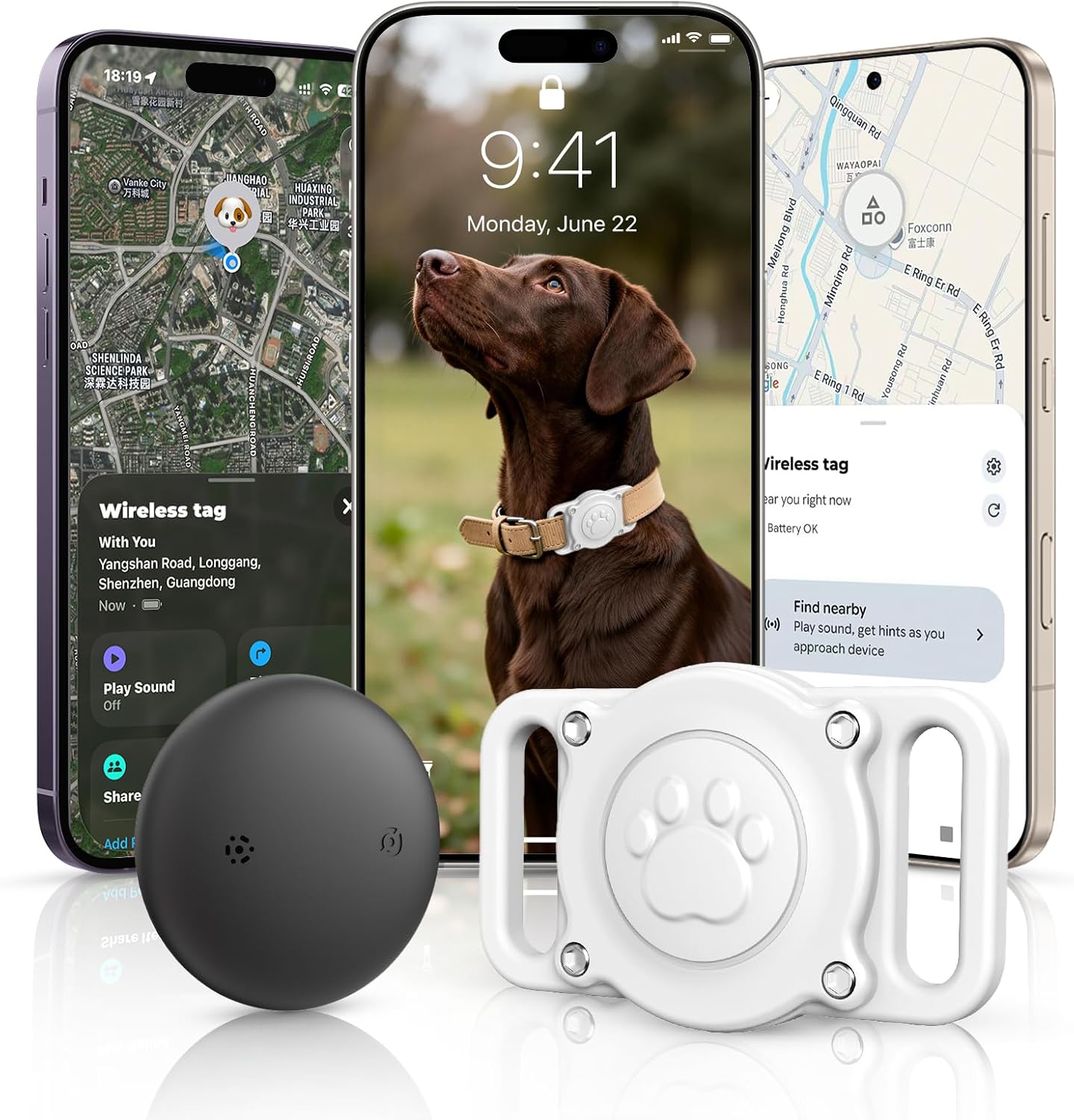
Budget pick: GPS Dog Tracker Collar (iOS & Android), Pet Activity Tracker No Monthly Fee
 Visit on Amazon →
Check current Amazon price. This is the collar I point people to when they want one dog tracked, activity numbers they will actually read, and no monthly fee attached. It pairs with both iOS and Android, which matters in a household where one person carries an iPhone and the other carries an Android. The phone is part of the workflow here: you set the dog up in the app, name the collar, and check activity through the day. For a fenced yard, neighborhood walks, and trailheads where you have bars, that is a complete setup.
Flaws but not dealbreakers: The phone is part of the workflow, and that is the honest limitation. If your dog runs where your phone has no bars, this is not the unit for that trip. Fit is also on you. A collar-mounted tracker that sits low on the neck catches brush, and brush wins.
Single-dog households, suburban yards, and day hikers who stay inside coverage will get the most out of this one.
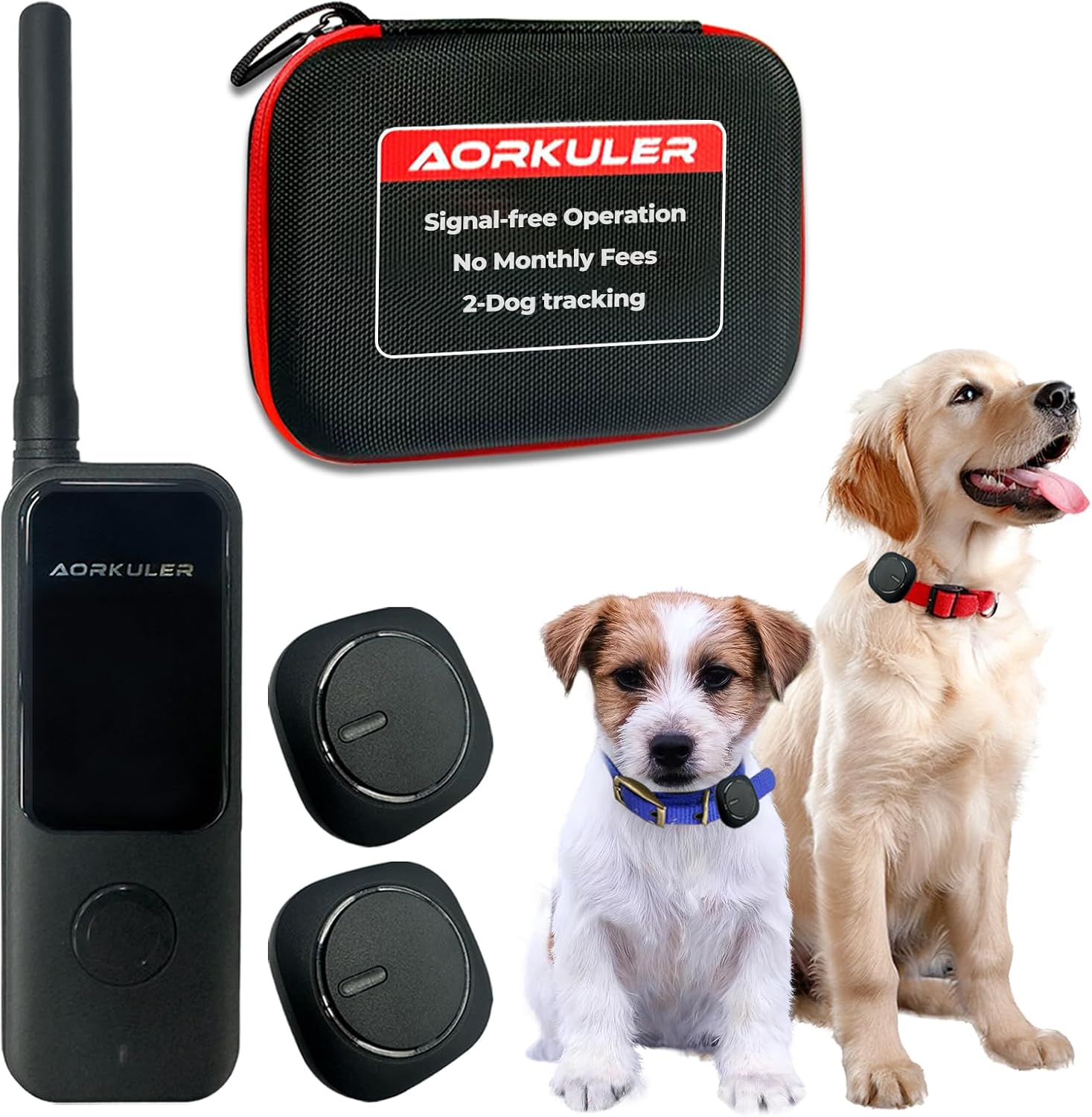
Best for two dogs: 2-Pack Outdoor GPS Dog Tracker for Two Dogs, Real-Time Tracking, No Phone or Signal Needed, Perfect for Hiking, Camping, Farms, and Large Open Spaces, No Subscription Fees
 Visit on Amazon →
Check current Amazon price. This is the pair I would carry into the canyon. Two units, real-time tracking, and the detail that decides the whole purchase for me: it does not need your phone or a signal. That is the difference between a tracker and a toy, because the places dogs go missing are exactly the places where your phone gives up. Farms, large open spaces, camping trips, and long hikes are the use cases this pair was built for, and two collars means two dogs covered without buying twice.
Flaws but not dealbreakers: Two units means two charge cycles, two collar fits, and two names to keep straight in the app. If you have one dog, you are buying a spare. Size the collar to your dog before the first walk, and check the fit again after a swim, because wet straps stretch.
Multi-dog households, farm and ranch dogs, and anyone hiking or camping off grid should start here.
Setting it up: the workflow that matters
Step one: Fit the collar before you touch the app. Two fingers of slack under the strap, unit sitting high on the neck behind the ears. Low-hanging trackers snag on brush and pop off, and a tracker in the bushes is a tracker you will never see again.
Step two: Charge every unit the night before, including the spare. Two dogs means two units, and the second one is the one people forget. Put both on the charger the night before a hike, not the morning of.
Step three: Name each collar in the app. If you run two dogs, name the units after the dogs, not after the hardware. When a geofence alert fires at 5 a.m., you want to know which dog is out, not which device number is beeping.
Step four: Walk the geofence. Set the boundary around the yard or the campsite, then walk the edge with the dog on leash. Watch how close you get before the alert fires. Every property is different, and a fence line you drew on a screen means nothing until you have tested it on foot.
Step five: Run a lock test in three places. Open meadow, dense pines, and the lowest point you walk. Time the first position in each spot and write the numbers down. This is the only coverage test that means anything, because it uses your terrain instead of a marketing map.
Step six: Pick your update interval on purpose. Live mode is for the moment a dog is missing. Recovery mode is for the eight hours before that. Set the everyday interval long enough that the battery lasts the whole outing, and switch to live updates only when the dog is actually gone.
Step seven: Test the light and the alert in the dark. Stand in your yard at night and trigger both. You want to know which button does what before you are doing it in the rain with a headlamp on your forehead.
Step eight: Keep a battery log. Start and end percentage, every trip, for a month. After four weeks you will know your real duty cycle instead of the number on the box.
The recovery drill
Live tracking is the fun part. Recovery is the part that brings a dog home, so practice it.
Hand your dog to a friend and have them hide with the dog at a spot you do not know about, somewhere inside your normal walking area. Then work the problem the way you would for real. Check the last known location first, note the time stamp, and walk to that point instead of staring at the live dot. When you get there, look for the direction of travel, not the current position.
Do this twice a month with each tracker, and time yourself. The first time, you will fumble the app. The fourth time, you will know exactly which screen shows the last position and which one needs a signal to refresh. That is the difference between a ten-minute recovery and an 11-hour one.
The other half of the drill is the part I learned the hard way. Call the neighbors. My husky's 11-hour search ended with a phone call from a woman two streets over, not with a dot on a map. A tracker buys you information. It does not replace the people around you.
What I'd skip
Bluetooth trackers that call themselves GPS. They work inside the yard and nowhere else, and "unlimited range" on the box means unlimited range from your phone. Once the dog leaves Bluetooth range, the tracker is a tag with a battery.
Cellular-only trackers with a monthly plan. They are fine in town. They are close to useless in a canyon, which is the place you actually need them, and the plan keeps billing whether the dog is home or not.
Anything that is not at least IP67. Dogs swim, roll in mud, and chew. A tracker without a water and dust rating is a donation to the forest.
Boundary and shock collars. Different product, different ethics, and not something I will recommend. This article is about finding a dog that is already gone, not correcting one that is still home.
What this costs over three years
The reason no-subscription hardware matters is not the sticker. It is the three-year math. A monthly plan that looks harmless at signup outruns the hardware itself by the second year, and it keeps charging after the novelty wears off. Hardware you own outright does not renew, does not raise its rate, and does not send you a reminder email you forgot to read.
The trade is real, though. No subscription usually means you are the one watching the battery and the one running the drills. That is a fair trade if you actually do it, and a bad trade if the tracker sits in a drawer until the day you need it.
So budget your attention, not just your money. Fit the collar properly, charge both units, walk your geofence, run the drill, and log the battery. Do that, and the one-time purchase turns into a working lifeline. Skip it, and you have bought a rock with a light on it.