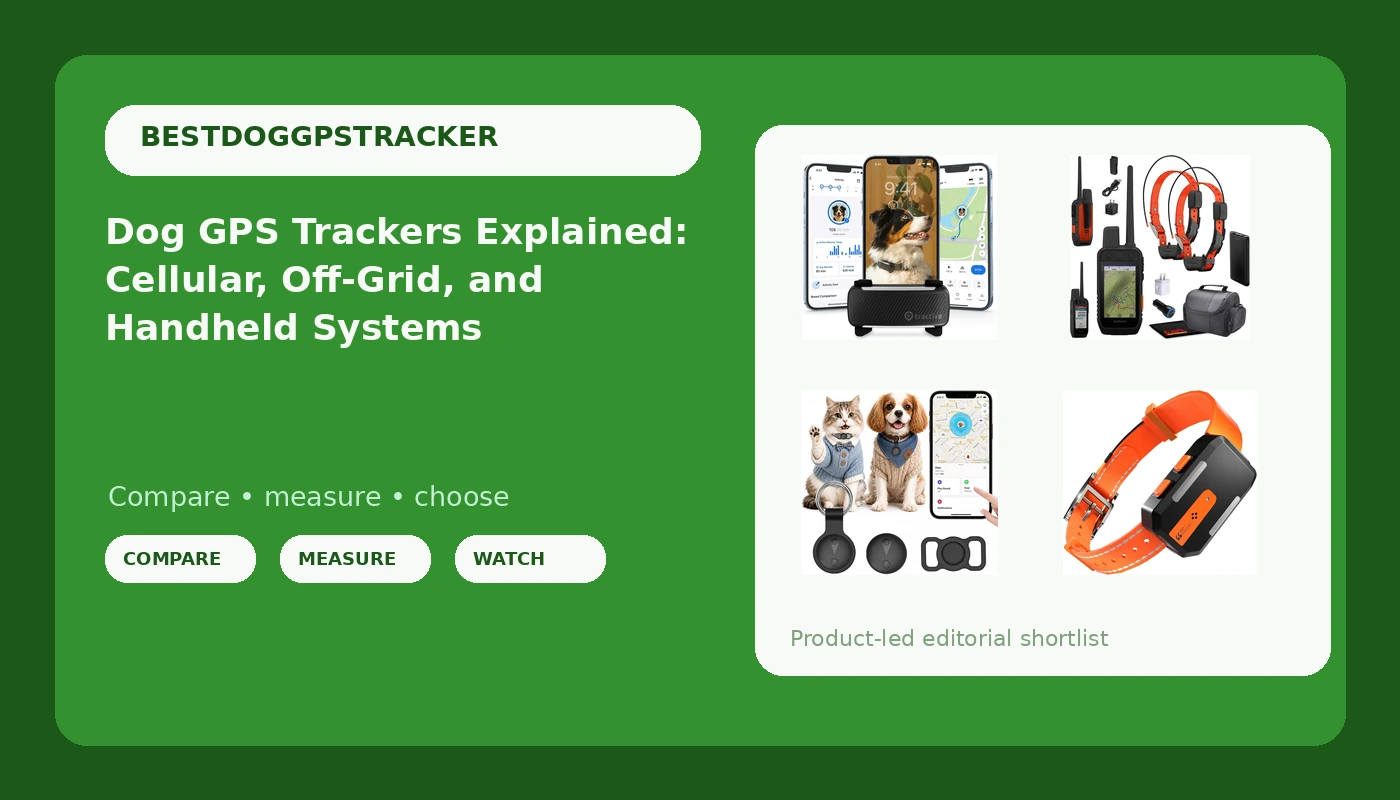
Most people start shopping for a dog GPS tracker after a scare, not before one. The gate was open, the dog was gone, and the first thing you learned is that a phone and a hopeful attitude are not a search plan. The hard part is that "GPS tracker" describes at least three different machines: a cellular live tracker that reports through a cell network, a no-fee off-grid unit that leans on satellite positioning plus a local link, and a handheld system with a dedicated receiver and collar. They solve different problems, and the one you buy should match the ground your dog actually runs on.
This guide explains the categories in plain language using four current listings as examples: the Tractive Smart Dog GPS Tracker, the Garmin Alpha 300i Handheld Dog Tracking 2-Collar Bundle, the No Monthly Fee Dog Tracker add-on unit, and a compact mini collar tracker. No prices appear here because they move; check the listing when you are ready to buy.
Related: Cellular vs Off-Grid Dog Trackers: Which One Survives No Bars →
Quick answer
There is no single best dog GPS tracker, and any page that names one is selling you something. The honest answer depends on three questions. Does your dog's range include places where your phone has no bars? Do you want to pay a monthly service plan? Do you want the location on a dedicated handheld, or on your phone? If you want live position updates, virtual fence alerts, and health monitoring delivered to an app, a cellular tracker like the Tractive unit is the natural fit. If you run deep canyons and dense pines where coverage dies, an off-grid or handheld system is the safer architecture. If you want to avoid a subscription entirely, read the no-fee listings closely and confirm exactly what the unit includes before you buy.
Four useful options
| Model | Best fit | What stands out |
|---|---|---|
| Tractive Smart Dog GPS Tracker | Owners who want live tracking and alerts on a phone | Live tracking with a virtual fence, plus heart and respiratory rate monitoring and bark monitoring |
| Garmin Alpha 300i Handheld Dog Tracking 2-Collar Bundle | Handlers who want a dedicated handheld and two collars | A handheld receiver bundled with two tracking collars |
| No Monthly Fee Dog Tracker (Add-On Unit Only) | Extending a system you already run off-grid | Advertised as no monthly fee and off-grid, sold as an add-on unit only |
| Pet GPS Tracker mini collar tracker | Small dogs and short-range peace of mind | Mini collar form factor, IP68 waterproof rating, no monthly fee subscription claimed, iOS Locate compatibility |
The live-tracking standard: Tractive Smart Dog GPS Tracker
Live tracking is a cellular product, and that shapes everything. The collar unit fixes its position with satellites, then hands that position to you over a cell network. Where you have bars, you get near-real-time updates and a geofence alert the moment your dog crosses the line you drew. Where you do not have bars, the app has nothing to show you until coverage returns. That is not a flaw in this particular unit; it is how the category works, and it is why the listing's virtual fence and monitoring features matter most for suburban and rural owners who still have signal. Note that the listing does not advertise a no-fee model, so budget for a service plan and confirm the current terms on the page before you commit.
The off-grid handheld system: Garmin Alpha 300i Handheld Dog Tracking 2-Collar Bundle
The reason this category exists is simple: the display is in your hand, not in a phone that needs a tower. Handlers who run multiple dogs, hunt, or work search and rescue tend to end up here because one receiver can manage more than one collar and the screen does not depend on a data plan to show a position. The trade-off is everything else about it. It is the most expensive kind of system in this guide, it is the bulkiest to carry, and a two-collar bundle only makes sense if you actually have two dogs or want a spare collar. If you are tracking one dog in a suburban yard, you are paying for capability you will never use. Confirm what the bundle includes and what service terms, if any, apply to the features you care about.
The no-fee off-grid unit: No Monthly Fee Dog Tracker (Add-On Unit Only)
Read "add-on unit only" twice before you buy. It means this is meant to extend a system you already have, not to be your first purchase. If you do not own the base hardware it pairs with, this listing will not get you tracking on its own, and that is the most common mistake buyers make with add-on listings. For someone already running a compatible off-grid setup, though, the appeal is obvious: no monthly fee, and a tracking approach that does not collapse when the towers are out of reach. That is the architecture that matters in the backcountry, and it is worth understanding before you spend anything.
The compact tag: Pet GPS Tracker mini collar tracker
Small trackers are a fit question more than a features question. A mini unit sits better on a small dog's neck and is less likely to catch on brush than a full-size box, and an IP68 rating is the right answer for dogs that swim or get rained on. The listing is also marketed for cats, which tells you the hardware is light, but escape physics differ between species, so judge it on how it performs for your dog. Two things to verify on the page: what "real-time" means in practice for update frequency, and how the iOS Locate integration behaves when your dog is outside the yard. Small-format trackers trade range and battery capacity for size, so go in with realistic expectations.
Prices and availability may change. Product images, names, and retailer links are matched to verified listings. No current price, rating, stock status, or measured result is stated here without current evidence.
How cellular, off-grid, and handheld tracking actually differ
Every one of these products does the same first job: it listens to satellites and works out where it is. The difference is how that position reaches you, and that is where the categories split.
A cellular tracker uses the mobile network as its messenger. Position goes from the collar to a tower to an app. When you have signal, this is the most convenient design by far: live updates, a virtual fence you can redraw from your couch, and alerts pushed to your phone. When you do not have signal, the messenger has nothing to carry, and you are waiting for the dog to wander back into coverage. That is the leash-versus-lifeline problem, and it is not solved by a better app.
An off-grid system skips the towers. Position is shared over a direct local link between the collar and a receiver or base unit you carry or keep nearby. No coverage, no subscription, but range is set by the radio link rather than by how close the nearest tower happens to be. Handheld systems work the same way with a dedicated display, which is why they appeal to handlers who do not want their tracking to depend on a phone at all.
The category to be skeptical of is Bluetooth. A Bluetooth tag is a short-range device wearing GPS branding. It works in a yard and fails at the tree line. If a listing promises unlimited range without a radio link, a subscription, or a receiver, the claim does not survive contact with the woods.
Subscription math, battery duty cycle, and recovery features
The subscription is the real price of a cellular tracker. A common service plan runs somewhere around $10 to $15 a month, which is roughly $360 to $540 across three years, and that is on top of the hardware. Sometimes it is more than the tracker itself. That is not an argument against subscriptions; it is an argument for doing the math before you buy instead of after. No-fee listings exist precisely because people get tired of paying for a full year of coverage they only use on weekend hikes. Whatever you choose, price the plan into the decision, and check whether it renews automatically.
Battery life is the next thing that decides whether a tracker is useful or decorative. Live tracking with frequent updates drains a battery fast. Recovery mode, which reports at longer intervals to preserve charge, keeps the unit alive through a long day but gives you coarser breadcrumbs. A tracker that dies at hour fourteen on a day hike is a rock with a subscription, so match the update interval to the length of your outings and build a charging routine around it.
Then there are the features that actually get a dog home. A last known location that survives a lost signal is the single most valuable screen in any app. A geofence alert that fires the moment your dog leaves the yard buys you minutes. A light you can trigger at night turns a dark treeline into a findable target. Live tracking is the party trick; recovery is the product.
- Map where your dog actually goes, not where you wish it went, and note whether that ground has cell coverage.
- Decide honestly whether you will pay a monthly plan, and if not, restrict your search to no-fee and off-grid listings.
- Choose your display: phone app for convenience, dedicated handheld for independence from towers.
- Check the attachment and the waterproof rating, because a tracker that falls off in thick brush or dies in a creek is a donation to the forest.
- Total the three-year cost, hardware plus plan, plus the cost of a replacement collar or charging cable your dog will eventually chew.
Practical guidance before you buy
- Fit the collar so the unit sits high on the neck and cannot swing free where brush can grab it.
- Walk your geofence boundary yourself and confirm the alert fires where you expect, not two streets later.
- Charge on a fixed schedule, not when the battery warning appears, and keep a spare cable in your pack.
- Keep a physical ID tag and an up-to-date microchip on the dog regardless of what the tracker claims.
- Test the recovery workflow once: open the app or handheld, find last known location, and time how long it takes you to read it.
Which option should you choose?
Choose the Tractive Smart Dog GPS Tracker when your dog's world is mostly covered by cell signal and you want live updates, a virtual fence, and health monitoring on your phone. Choose the Garmin Alpha 300i Handheld Dog Tracking 2-Collar Bundle when you run multiple dogs or work off-grid terrain and want the position on a dedicated handheld instead of a phone. Choose the No Monthly Fee Dog Tracker (Add-On Unit Only) when you already own a compatible off-grid system and want to extend it without adding a subscription. Choose the Pet GPS Tracker mini collar tracker when you want a small, waterproof, subscription-free tag for a small dog and your expectations are set at short-range peace of mind rather than backcountry recovery.
One caveat applies to all four: this guide describes what the listings advertise, not measured performance. Update frequency, real-world range, battery behavior, and service plan terms are the details that decide whether a tracker works for you, and those live on the product page, not in a summary table.
The bottom line
The right dog GPS tracker is the one that still works where your dog runs. If that is a fenced yard and a neighborhood park, a cellular tracker with a virtual fence gives you the most information for the least hassle, provided you are willing to pay for a plan. If it is canyon country with no bars, no-fee off-grid hardware or a handheld system is the architecture that survives. Decide on coverage and subscription first, size and attachment second, and features last, because a long feature list does not matter if the unit is sitting in a drawer with a dead battery.