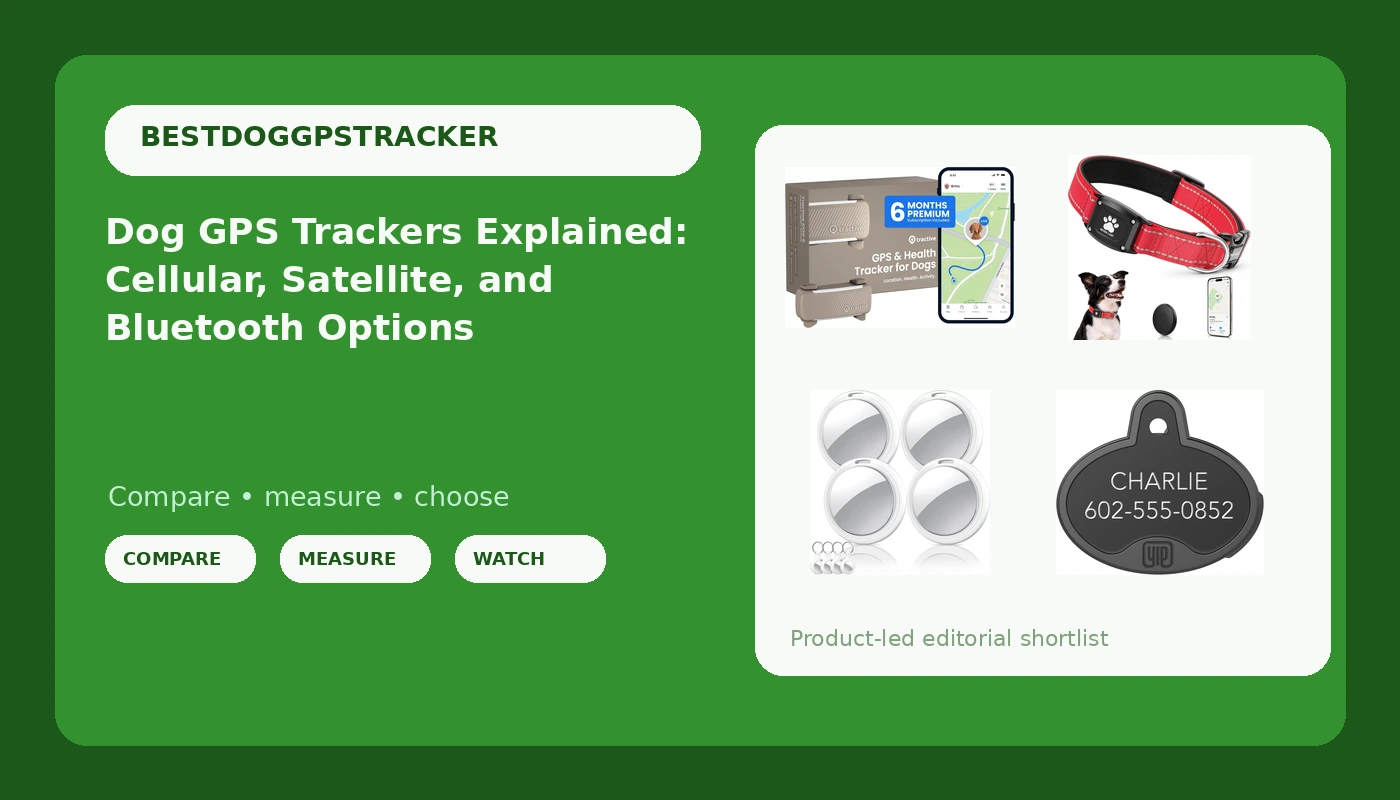
Most people shopping for a dog GPS tracker are really asking one question: will this thing still tell me where my dog is when my phone has no bars? The answer depends far less on the brand name than on which radio is doing the work. A satellite receiver paired with a cellular radio can report a live position from almost anywhere, and that is exactly why it carries a monthly plan. A Bluetooth tag that rides a crowdsourced finding network costs almost nothing to run, but it depends on strangers' phones being nearby. A collar advertised as having no monthly fee sits somewhere between those two, and the product listing is the only honest place to learn which technology it actually uses.
This explainer walks through four options that look similar on a shelf and behave nothing alike in the field, then lays out the questions worth answering before you spend anything on a dog GPS tracker.
Related: Best Dog GPS Trackers for Off-Grid Hikes →
Quick answer
There is no single best dog GPS tracker, because these four options solve different problems. If you need a live position in country with no cell service, choose a tracker that includes a subscription and plan for the renewal. If recurring fees are the dealbreaker, choose a no-fee collar or a platform tag that matches the phone in your pocket. If what you actually want is identification plus a last-resort location nudge in populated areas, an engraved tag with finding built in covers the base that matters most. Match the technology to where your dog actually escapes, not to the longest feature list.
Four useful options
| Model | Best fit | What stands out |
|---|---|---|
| Tractive Smart Dog GPS Tracker with 6 Month Subscription | Owners who need live tracking and health signals | Includes a 6 month subscription; live tracking with a virtual fence; heart and respiratory rate plus bark monitoring |
| GPS Dog Collar with Tracker, Waterproof, No Monthly Fee, Red, L | Buyers who want no recurring bill and a collar built for wet conditions | Complete collar with the tracker built in; advertised as waterproof with no monthly fee; size L in red |
| YIP Smart Tag ID & Custom Engraved Dogs Tracker | Samsung Galaxy owners who want identification and location in one tag | Custom engraving; compatible with Samsung Galaxy; advertised with no GPS subscription or monthly fee |
| Air Tracker Tags 4 Pack | Apple households that want several tags for pet gear and belongings | Four tags with four cases; works with Apple Find My, iOS only; Bluetooth finding rather than satellite GPS |
Live tracking: Tractive Smart Dog GPS Tracker with 6 Month Subscription
The trade-off here is the one that decides most purchases: the hardware is a one-time cost, but the service is not. A tracker that reports live positions needs a data path, and that path is rented. Do the three-year math before you buy, because the renewal is usually the larger number. Coverage is the second catch. A cellular tracker is only as good as the bars where your dog is standing, which is why the recovery features matter as much as the live map. Ask yourself what the app shows when the signal drops, and whether last known location is visible without a connection.
The no-fee collar: GPS Dog Collar with Tracker, Waterproof, No Monthly Fee, Red, L
A no-fee product is appealing for obvious reasons, and it is also where marketing language does the most work. "No monthly fee" tells you about billing, not about range. A device can avoid subscriptions by using a free finding network, by storing positions on the collar for later download, or by using a radio path that only works over short distances. Those are very different products. Before you commit, find the sentence in the listing that explains how the position gets to your phone. If you cannot find it, treat the coverage claim as unproven. Also check fit, since a size L collar on a smaller dog slides and a loose collar is how trackers end up in the brush.
The Samsung-compatible tag: YIP Smart Tag ID & Custom Engraved Dogs Tracker
The engraved ID is the underrated half of this product. Most lost dogs go home because a stranger reads a phone number off a tag, not because an app drew a dot on a map. Adding a finding network on top of that is a bonus, not a replacement. Be clear about the limits: this class of tag does not receive satellite signals, so it cannot report a position in an empty forest or a canyon with no phones in it. It is a suburban and urban tool, and for a lot of owners that is exactly the right scope.
The Apple multi-pack: Air Tracker Tags 4 Pack
Buying four at once makes sense if you have more than one thing that goes missing: a second dog, a travel crate, a go bag, a set of keys. The pack spreads the cost across several jobs. What it does not do is change the physics. If your dog's escape route leads away from people and their phones, a Find My style tag will show you the last place it was seen by a passing device, and then nothing. For a dog that bolts out the front door into a neighborhood, that is often enough to recover them in minutes. For a dog that runs a ridge line, it is not.
Prices and availability may change. Product images, names, and retailer links are matched to verified listings. No current price, rating, stock status, or measured result is stated here without current evidence.
How satellite, cellular, and Bluetooth actually differ
The word "GPS" gets used for three separate jobs, and untangling them explains almost every confusing product claim. The first job is receiving. A GNSS receiver listens to satellite signals and calculates where it is. That part is free, and it works with no cell service at all. The second job is reporting. Knowing your own coordinates is useless to an owner standing two miles away unless something carries that position out. That carrier is usually a cellular network, and that is the piece you rent. The third job is finding. A Bluetooth tag does not calculate anything from satellites. It broadcasts, and nearby phones that belong to other people quietly relay an approximate location.
That is why "no monthly fee" and "GPS" can both appear on the same package without contradicting each other. It also explains the coverage lie you see on cheap tags. Unlimited range is a meaningless phrase on a Bluetooth product, because the range is not measured in miles, it is measured in how many participating phones happen to be within a short distance of your dog. In a dense suburb, that can be constant. In the Deschutes National Forest, it is nothing.
Two features deserve priority over the live map, whichever technology you choose. The first is last known location, which should be visible without a fresh connection. The second is a geofence, a boundary you draw that triggers an alert when your dog crosses it. A geofence catches an escape in the first minute, when the dog is still close, instead of at hour three when it is a mile away. Add a light you can trigger remotely and you have the recovery toolkit that actually shortens searches.
What the monthly fee buys, and why battery life is the whole product
If you choose a subscription tracker, the fee is not a nuisance, it is the product. The hardware is a receiver and a radio; the service is the network that moves data, the app that stores history, and the alerts that wake you at 2 a.m. That means the honest comparison is three years of ownership, not the checkout total. A plan that renews annually can quietly outspend the collar several times over, and auto-renewal terms vary by brand, so read them before the free period lapses.
Battery life follows from the same design choices. A tracker in live mode, updating constantly and pushing data, drains fast. The same tracker in a lower duty cycle, reporting on a schedule and holding last known location, lasts much longer. Neither mode is wrong; they answer different questions. A day hike wants frequent updates. A week of ordinary yard time wants a device that is still alive on day six. Before any trip, confirm the charge level and know how long the tracker runs in each mode.
Durability is the other half. A dog will swim, roll in mud, and chew the thing attached to its neck. A tracker rated IP67 resists water and dust, which is the minimum for a dog that goes anywhere near a river. The attachment matters just as much as the rating: a weak clip or a loose collar is how trackers end up on the forest floor instead of on the dog.
- Decide where your dog actually gets lost. If it is the front yard or the neighborhood, a Bluetooth or platform tag may cover you. If it is open country, you need a satellite receiver with a cellular path.
- Check what your phone supports. Some finding tags are tied to Apple devices and others to Samsung Galaxy phones, and the wrong ecosystem makes the tag useless to you.
- Do the three-year math on any subscription tracker, including renewal terms and what happens if you let the plan lapse.
- Find the sentence in the listing that explains how position data reaches your phone. If that sentence does not exist, assume the coverage claim is unverified.
- Verify fit, attachment, and water resistance before the first outing, then test the whole setup in a fenced area at home.
Practical guidance before you buy
- Charge the tracker and run it at home for a few days first, logging how fast the battery drops in each mode, so you are not learning its limits during an emergency.
- Keep a plain engraved ID tag on the collar no matter which tracker you choose, because a stranger with a phone number is still the most common way a lost dog gets home.
- Fit the collar so it cannot slip over the head but still leaves room for two fingers, and check the attachment point every time you put it on.
- Set a geofence around the yard and any place you visit often, and confirm the alert reaches your phone while you are standing next to the dog.
- Walk the boundary of your usual off-leash area and watch what the app does as coverage changes, so you know in advance where the map will go blank.
Which option should you choose?
Choose the Tractive Smart Dog GPS Tracker with 6 Month Subscription when you need a live position in places where your phone has no bars and you are willing to pay a recurring fee for it. Choose the GPS Dog Collar with Tracker, Waterproof, No Monthly Fee, Red, L when a recurring bill is the dealbreaker and you want the tracker integrated into a collar built for wet conditions. Choose the YIP Smart Tag ID & Custom Engraved Dogs Tracker when you carry a Samsung Galaxy phone and want engraved identification plus a locator that works through the phones around it. Choose the Air Tracker Tags 4 Pack when you are in the Apple ecosystem and want several tags for a dog, a bag, and everything else that goes missing.
One caveat applies to all four. The details that decide whether a tracker performs, meaning coverage path, plan terms, battery life in each mode, and water and chew resistance, live in the listing and in the manual, not in a headline. Confirm them for your own dog, your own terrain, and your own phone before you rely on any of it.
The bottom line
The technology matters more than the brand. Satellite reception plus a cellular path gives you live tracking almost anywhere and charges you monthly for it. Bluetooth finding gives you free, neighborhood-scale locating that fails where there are no phones. An engraved ID tag gives you the recovery route that works even when every battery is dead. Pick the one that matches where your dog gets loose, budget for the recurring cost if you choose the subscription route, and test the setup at home before you need it in the dark.