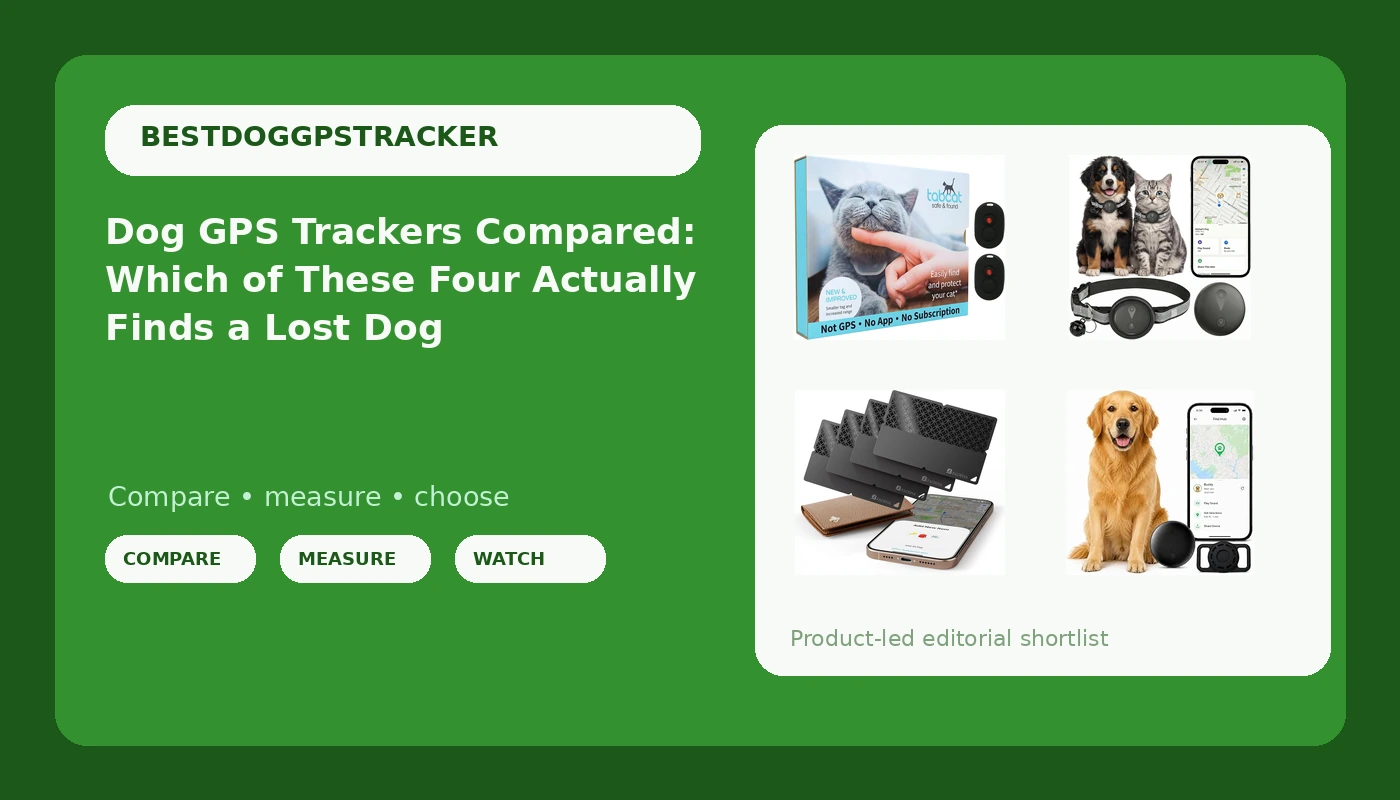
Most dog GPS tracker comparison articles line up four boxes, compare the spec sheets, and declare a winner. I cannot write that article, because the four trackers in this dog GPS tracker comparison are not four versions of the same tool. Two of them find things by borrowing other people's phones. One finds things by radio direction. One is a wallet card that happens to be very good at not getting lost.
I have spent four years and roughly 2,000 trail miles testing trackers on a husky who treats fences as suggestions. One of those tests ended with 11 hours in the Deschutes National Forest and a neighbor's phone call, not an app notification. That failure taught me more than any satellite lock time I have ever logged. So when I look at a tracker, I am not asking whether the app is pretty. I am asking what happens at hour 14, in a canyon, with no bars.
One honest note before the table: I have not had these four specific units on a collar in the backcountry yet. What I can do is apply the same checklist I use on every tracker that crosses my bench, read each listing for what it actually claims, and tell you which of these four is worth your money and which is a category mismatch. That is more useful than a fake winner.
Related: GPS Tracker Vs Bluetooth Tracker For Dogs: What Actually Works Off Grid
If you want the strongest hardware in this group, the 2026 Apple MFi Certified Wallet Tracker Smart Card is the pick, but only for iPhone households whose dogs stay in populated places. For off-grid recovery, none of these four is the answer, and I would rather tell you that than sell you a false sense of range.
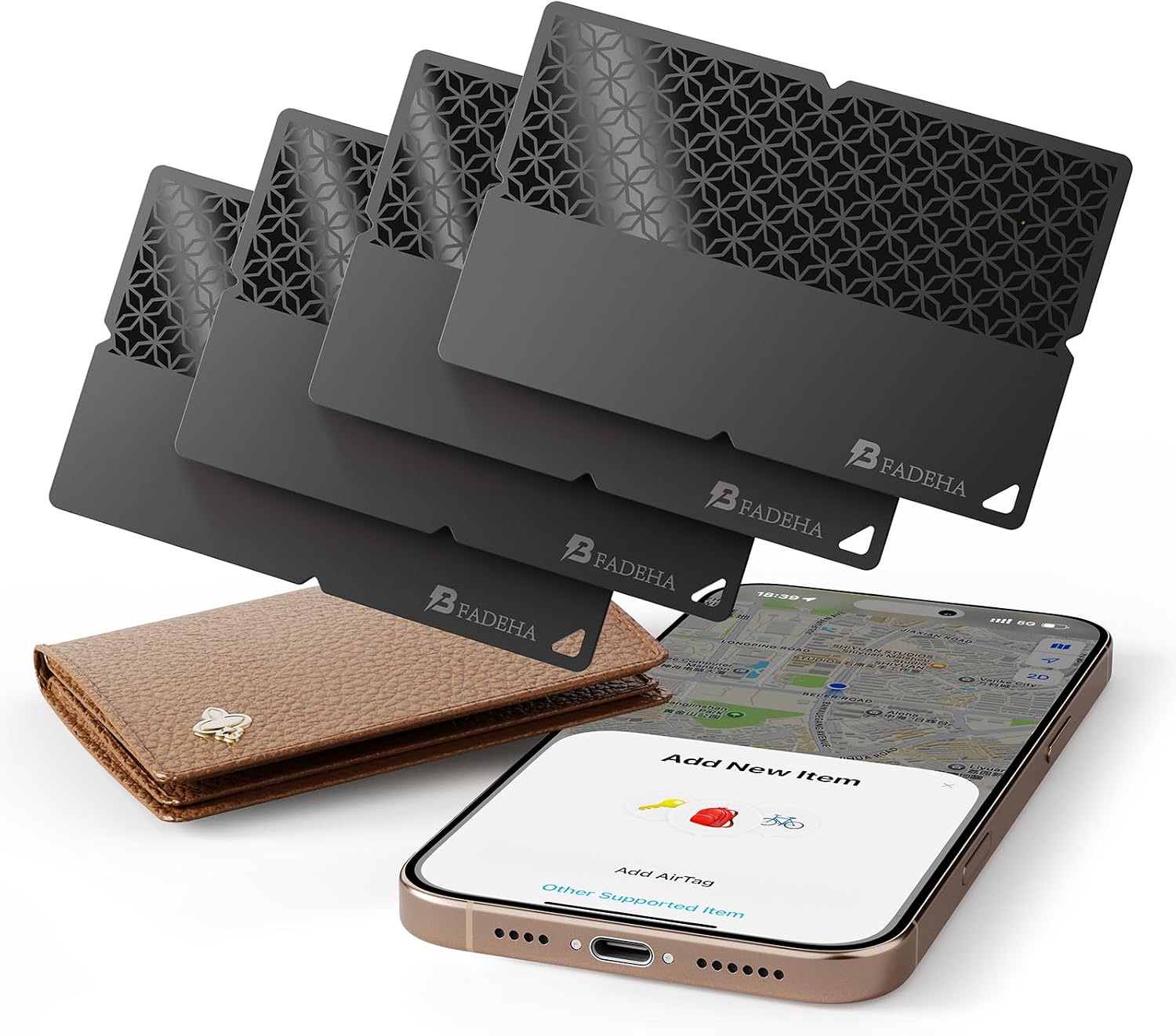
2026 Apple MFi Certified Wallet Tracker Smart Card for Find My iPhone
Ultra thin card form, IP69 waterproofing, five years plus of staying power, no charging ritual to forget
It is an item locator, not a pet tracker: no collar attachment, and it depends on the Find My network being nearby
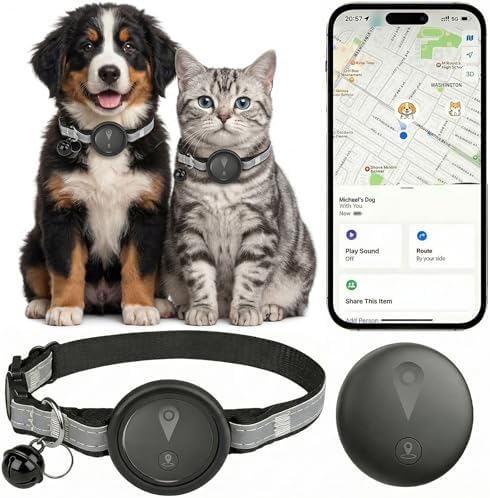
Tracker - Ideal for Small, Medium, and Large Pets
The only tag here explicitly sized across small, medium, and large pets
The listing name states no radio standard, no battery claim, and no IP rating I can verify, which is the whole question with a tracker
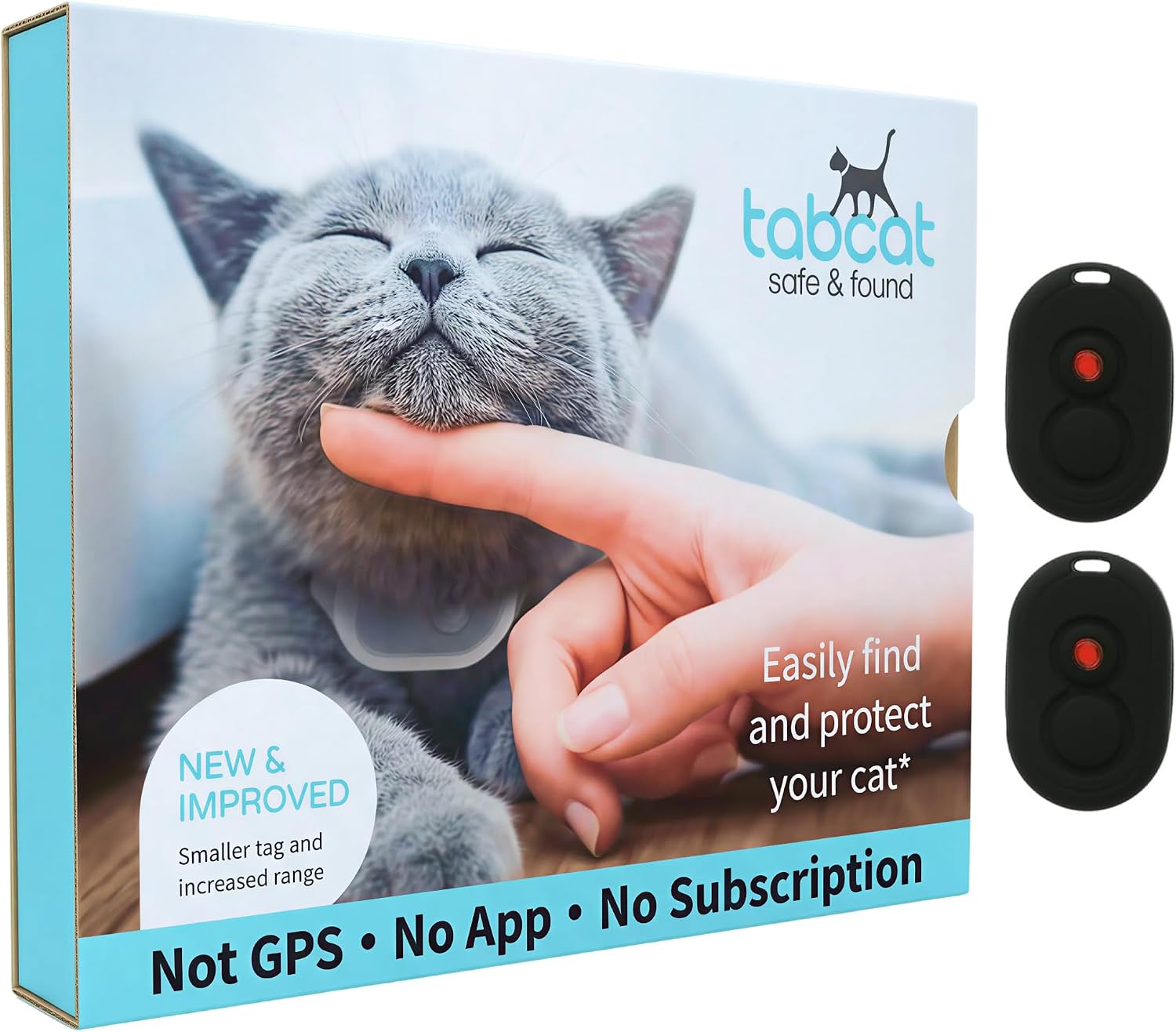
Tabcat V2 Cat & Kitten Tracker with 2 Homing Tags
No subscription, two tags included, radio homing that does not need a cell tower, genuinely small and light
150m range makes it a house and yard tool, and it is built for cats, which is a different escape problem
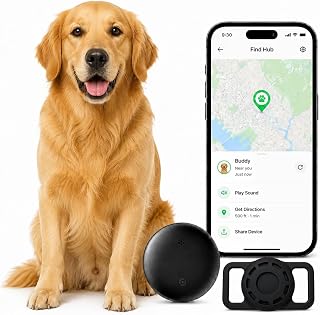
GPS Collar for Dogs, Pet Tracker (Android Only) Smart Tag
Lowest entry cost here, collar form factor, waterproof, and no monthly fee
Android only, and the name says GPS while the listing says Google Find My, which are two different jobs
Prices and availability were captured from Amazon Creators API and may change.
How I judge a tracker
Every tracker that comes through my hands gets the same four questions, in this order.
First, how does it fix a position? Satellite direct (GNSS), or by borrowing nearby phones on a crowd network, or by radio direction finding? This determines everything else. A crowd network tracker is a miracle in a suburb and a paperweight in a canyon, because there is no crowd.
Second, what is the battery duty cycle? Not the standby number on the box. I care about how often it wakes up, locks, and reports, and how much of the battery that eats across a real day hike. A tracker that dies at hour 14 is a rock with a subscription.
Third, what is the durability and the attachment? IP67 is my floor, IP69 is better, and the mount matters more than the rating. I have found two trackers in the woods, and neither was attached to a dog. Thick brush eats flimsy clips.
Fourth, recovery features. Live tracking is a party trick. The things that bring a dog home are last known location, a geofence alert that fires when the dog leaves, and a light I can trigger at night so I can see the collar in a headlamp beam.
Run these four trackers through those four questions and the picture gets clear fast.
The Apple wallet card: excellent hardware, wrong animal
The 2026 Apple MFi Certified Wallet Tracker Smart Card is the best-built object in this comparison. IP69 waterproofing, a card that disappears into a wallet or a bag, and five years plus of staying power means you are not plugging anything in every third night. For an iPhone owner who keeps losing keys, bags, or a passport, it is a straightforward buy.
It is also not a dog tracker. There is no collar mount, no geofence designed around a wandering animal, and no light to trigger. If you clip it to a harness, you are using an item locator as a pet tracker, and the failure mode is ugly: you get a last known location from the last time a stranger's iPhone walked past your dog. That is a recovery feature in a city. On a trail, it is a history lesson.
The generic pet tracker tag
The listing simply called Tracker - Ideal for Small, Medium, and Large Pets is the most pet-shaped product here. That sizing language matters, because a tag that fits a large dog without bouncing and still sits flat on a small one is genuinely harder to make than people think.
The problem is what the name does not say. No radio standard. No battery claim. No IP rating. With trackers, the specification is the product. When a listing will not tell me whether the thing uses a crowd network, satellite, or radio, I cannot tell you what it will do when your dog is 400 meters into pines. That is not a knock on the hardware, which I have not tested. It is a knock on the information. Ask before you buy, or buy somewhere with a real return window.
The Tabcat V2: radio homing, and why I do not review cat trackers
I do not review cat trackers, and I am not starting now. Cats and dogs have different escape physics, and my whole testing protocol is built around a dog that runs a ridge line. The Tabcat V2 is in this comparison because it was on the list and because it is the only product here that does not depend on a phone network at all.
That is worth understanding. Radio homing means a handheld unit points you toward the tag, and the Tabcat V2 lists up to 150m of range with two homing tags and no monthly fee or subscription. No cell coverage, no crowd, no satellite lock. For an indoor cat that slips into a neighbor's garage, that is a genuinely elegant solution, and the two-tag bundle is smart packaging.
For a dog on open ground, 150m is a house and yard tool. A husky can cover that in under a minute, and then you are walking a grid with a directional beeper. Useful, but not the same job.
The Android-only collar: cheap entry, naming problem
The GPS Collar for Dogs, Pet Tracker is the budget door into tracking. Collar form factor, waterproof, Android only, no monthly fee, and it lists compatibility with Google Find My. For a family that wants a cheap way to know the dog is on the property, that is a real offer.
Here is my one editorial complaint, and it is the same complaint I make every month. The name says GPS. The listing says Google Find My. Those are different technologies with different failure modes. A Find My style tag is a crowd network device: it reports when another compatible phone is close enough to hear it. In a neighborhood, that is constant. In a national forest, that is nobody. If the listing told you plainly that this is a network tag and not a satellite tracker, I would have nothing to complain about. Android only is a hard limit too, so iPhone households should not even consider it.
The subscription math
This is where this group surprises me, in a good way. All four of these list no monthly fee or no subscription, which is the opposite of most dedicated dog GPS trackers I have tested. Ten to fifteen dollars a month is 360 to 540 dollars over three years, and that is more than the hardware in most cases. None of that applies here.
But you are not getting free satellite tracking. You are trading the subscription for a network dependency. The Apple card and the Android collar lean on other people's phones. The Tabcat leans on radio range. The generic tag does not say what it leans on. No bill is genuinely nice. No bill and no coverage is not a bargain, it is a different product.
Trade-offs you cannot design around
The trade-off in this comparison is not price and it is not build quality. It is where the dog goes.
If your dog lives inside a suburb, walks on sidewalks, and escapes into a fenced neighborhood, a crowd network tracker is close to magic. There are phones everywhere, and a last known location updates every few minutes.
If your dog runs trail, chases game, or lives anywhere with a canyon, a crowd network tracker will hand you a dot from twenty minutes ago and a whole lot of nothing else. That is not a flaw in these products. It is the wrong tool, and the marketing does not always say so.
The other trade-off is attachment. None of these four is a purpose-built collar tracker with a locking mount, except the Android collar. Everything else needs a clip, a pouch, or a harness pocket, and clips are where trackers die. Test the mount before you test the tracker.
What I would actually buy from this list
For an iPhone household with a dog that stays in town, I would buy the 2026 Apple MFi Certified Wallet Tracker Smart Card. The hardware is the best here, the waterproofing is the highest rated, and the staying power means you will not be charging it every other day. Put it in a harness pouch, set up notifications, and understand that it tells you where your dog was near people.
For an Android household on a tight budget, the Android-only collar is the honest cheap option, with the same network caveat attached.
If your dog is a genuine flight risk, I would not buy any of these four. I would buy a satellite direct tracker with a real subscription and a collar mount that survives brush, because the subscription is the price of the lifeline, not the price of the app. That is the same advice I give on my SAR team when someone asks me what to put on a dog that has already run once.
The Tabcat V2 stays on the shelf for dogs, and it is a smart buy for the cat owner in your life.
What I am watching next
Two things. First, satellite direct trackers are getting cheaper, and I expect the consumer price floor to drop hard within three years. When that happens, the crowd network trackers lose their main advantage, which is a low upfront cost. Second, watch battery chemistry rather than app features. The tracker that wins the next two years will be the one that holds a duty cycle through a cold night, not the one with the prettiest map.
I keep a dated log of these predictions and score them each January. So far I am right about the direction and wrong about the speed, which is the usual result.